

Embridge Consulting appointed as exclusive UK Public Sector reseller for Unit4
How council leaders can succeed in the Shadow Authority phase of devolution
ArticleDecember 20256 min

Annabelle Fox

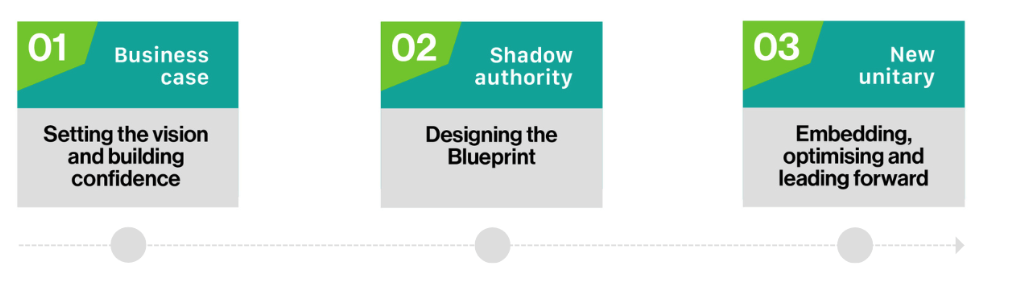
Stepping into the Shadow Authority phase marks a decisive shift in the journey toward becoming a new unitary council. This is the point where leadership structures, operational systems, and service delivery frameworks start to take tangible form, and the pressure on leadership teams to give staff clarity and maintain morale begins to increase. It’s a demanding stage, and leaders often feel the strain of balancing today’s services with tomorrow’s structures. The choices made now will influence day-one operations and long-term success.
The Shadow Authority phase matters because it shapes everything that follows. Decisions made during these months influence how services are structured, how staff are supported, how data is protected and shared, and how smoothly the new organisation will function on day one. Councils that approach this stage with clarity and coordination can avoid disruption and set strong, sustainable foundations for the years ahead. Those that underestimate its complexity often encounter delays, governance gaps, and operational strain that can ripple well beyond vesting day.
In this guide, we’ll explore why this phase of local government reform is so pivotal in the wider devolution process and highlight the pressures and priorities councils should expect as responsibilities begin to shift. From the challenge of aligning multiple leadership teams to the practical work of consolidating systems and preparing staff for change, this phase demands structure, pace, and clear decision-making. While the full guidance is outlined in our latest whitepaper, this overview identifies the core pressures and priorities councils must be ready to manage as they shift from planning to delivery.
The leadership challenge: bringing direction and stability to a temporary structure
One of the defining features of the Shadow Authority phase is its temporary nature. Councils must assemble leadership structures that will guide the transition without disrupting ongoing work across existing authorities. This is a high-pressure stage, and leaders often feel the strain of balancing urgent operational demands with the need to set a clear direction for the future. This often means balancing continuity with the need to establish a new strategic direction, all while working within tight timelines.
Leadership teams face the challenge of creating clarity around roles, responsibilities, and decision-making while multiple organisations continue to operate in parallel. The weight of accountability, combined with competing priorities, can make decision-making particularly complex at this stage. Aligning political, executive, and operational leadership becomes central to progress, particularly where existing authorities have different priorities, financial positions, or service delivery models.
Clear and consistent leadership remains one of the strongest determinants of how effectively the new unitary authority will function on day one. Councils that invest time in strengthening interim governance and fostering joint working early often find the rest of the transition easier to manage. Acknowledging and managing this leadership pressure early can help maintain staff confidence and keep the wider transition on track.
How to align council operations and technology for unitary transition
While leadership sets the direction, systems and processes determine whether the new authority can operate effectively from the outset. This part of the Shadow Authority phase is often more complex than anticipated, particularly where councils use different technologies, data structures, or operational models. Leaders must also consider how these operational decisions will be experienced by staff and residents, as uncertainty can quickly erode confidence and trust.
Bringing systems together requires careful planning to avoid disruption to high-risk areas such as finance, HR, social care, and customer services. Even without moving into detailed implementation, councils must begin shaping the operational model, agreeing which systems will be retained, which will require consolidation, and how data will be managed safely throughout the transition.
Workforce planning plays an equally important role. Staff need clarity on future structures, roles, and reporting lines, and uncertainty during this period can have a real impact on morale and service continuity. Ensuring staff feel informed, supported, and confident in the changes helps maintain engagement and service quality, while clear communication with residents protects public trust. Transparent communication, early engagement, and a coordinated approach to organisational design help reduce disruption and ensure teams remain aligned with the longer-term goals of reform.
Why the Shadow Authority phase drives future outcomes in devolution
The Shadow Authority phase is often seen as a transitional stage, but it is, in fact, one of the most consequential points in local government reform. Decisions made now not only influence governance clarity and service delivery but also shape staff confidence and resident trust in the new authority. Getting this phase right positions councils to step confidently into the new unitary authority, protecting both operational continuity and public trust.
Councils that approach this phase proactively often see smoother integration, stronger financial stability, and better relationships between leadership teams and staff. By addressing challenges early, leaders can reduce stress and uncertainty for employees, helping teams feel secure and empowered during the transition. Those that leave key issues unresolved until vesting day frequently encounter operational challenges that take months or even years to correct.
With so much at stake, clarity, coordination, and structured planning are essential. These are the principles underpinning our latest whitepaper, which offers practical support through diagnostic checklists and a clear day-one readiness structure, helping councils navigate the leadership, systems, governance, and workforce considerations that shape this stage of reform. It provides the answers to the questions that typically emerge during this transition and gives councils the tools needed to manage the Shadow Authority phase with confidence and control.
This blog offers only a high-level view of the challenges councils face during the Shadow Authority phase. For a more detailed exploration of the actions, risks, and considerations that underpin a successful transition, download the full whitepaper ‘From planning to practice: Leading the Shadow Authority phase of local government reform’.
If you’re still in the Business Case stage, you can also access our first guide ‘No time to waste: Building strong business cases for devolution’ to help councils establish a clear governance model before moving into the Shadow Authority phase.